Stranger Than Fiction
biological horror in books and biomes

[photo by Wyxina Tresse on Unsplash]
Horror is currently my favorite fiction genre. Last year, around 90% of the books I’ve read were horror, and this year is looking pretty similar. I wasn’t a horror fan as a kid though – science fiction was my main jam. Then I got two biology degrees and was introduced to a wide range of the mysterious and the macabre inhabiting our planet. I started exploring horror in all kinds of media, books and games and movies and creepypastas, and I fell in love.
The world of living things is bizarre. Natural selection operates on a very basic principle – whatever survives and reproduces will continue to survive and reproduce – and yet it brings forth adaptations that would fit comfortably into a horror novel. From unexplored ecosystems to natural abilities that defy explanations, the world around us if full of dark beauty.
For this article, I want to discuss five horror novels that have some sort of biological component (whether body horror, fungal/botanical horror, or something else entirely), along with science facts in some way related to the story. For each section, I will be linking an article you can check out to keep learning.
(This is a companion piece to “You Are a Hivemind”, a video essay I am currently editing. Once the video will be out, I will edit this post and add a link.)
“Wolf Worm” by T. Kingfisher
When I first came across this book, the cover and the blurb reminded me of Silvia Moreno-Garcia’s “Mexican Gothic”, another atmospheric story set in an old, mysterious mansion on the edge of human settlement. Though the tone and the plot are quite distinct, these stories do share one thing in common: a non-human culprit at the heart of the mystery. In the case of “Wolf Worm”, it is, well, worms. A pretty distressing number of worms.
The book is explicitly inspired by real parasitic infections, such as the screwworm, which has been a primary target of research and elimination efforts for decades. It is a parasite that mostly targets cattle, though human infections occur as well. And while it is nasty, it is far from the freakiest parasite I’ve ever learned about. For example, our planet is the home to an incredible diversity of parasitoid wasps.
When most of us think of wasps, we might imagine a yellowjacket or a paper wasp – a social carnivore which builds nests and hunts small insects (or steals crumbs from your picnic table). But these wasps represent a minority in the group, since most creatures we call “wasp” are solitary. And many of them do not build nests or feed their larvae themselves, instead relying on hosts to survive and reproduce.
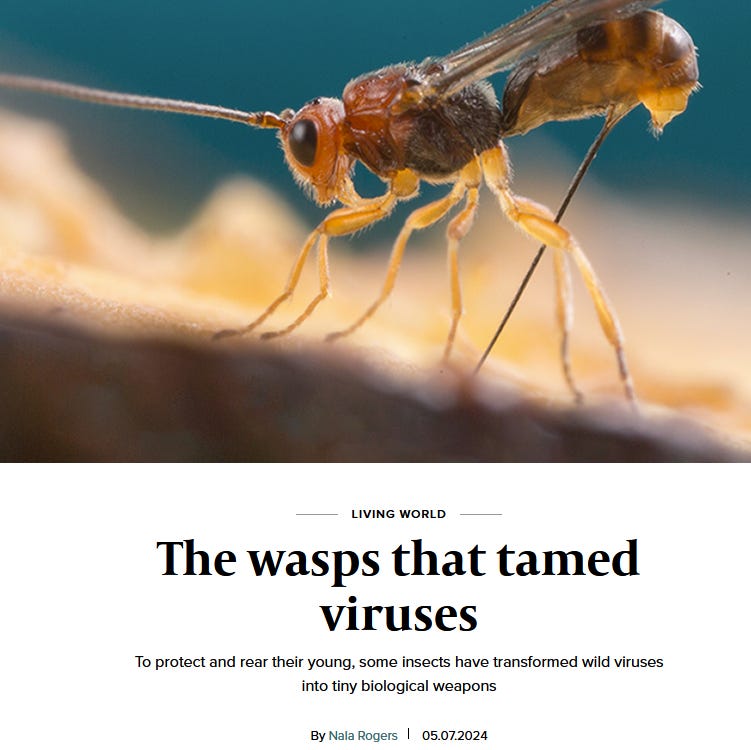
Parasitoid wasps have evolved a great variety of adaptations to ensure they can successfully place their eggs into the bodies of their victims. For one, they do not kill the host immediately, so that their larvae can continue to feed while they develop. They can also paralyze their hosts using their ovipositors, the same organ that allows them to deposit the eggs. But perhaps the most peculiar adaptation is the use of viral vectors observed in several species.
https://knowablemagazine.org/content/article/living-world/2024/parasitoid-wasps-domesticate-viruses
Not one, but several species of parasitoid wasps use their ovipositors to inject a virus instead of a venom. The vector can, for example, subdue the immune system of the host and help their own larvae to survive. The cooperation between the wasp and the virus is not coincidental: scientists describe this strategy as a kind of “domestication”. And there is no consensus of whether the viral DNA is now completely ingrained into the wasp’s body. Where does the wasp end and the virus begin?
“You Weren’t Meant to Be Human” by Andrew Joseph White
Andrew Joseph White’s adult debut is an emotionally difficult book to read, especially if, like me, you share identity with its protagonist. It was also my favourite book of 2025. Although the supernatural elements exist mostly in the periphery, the story keeps you in a tense, discomforting embrace, and continuously raises that tension until a devastating crescendo. The final few chapters are not for the weak; the imagery it creates will haunt you, and the character arc is one of the best I’ve read in horror.
One of the central sources of discomfort in the story is the experience of unwanted pregnancy. Carrying a child is a divisive experience; for some, it is a source of great joy and personal meaning, while for others, it is a traumatic event.
Pregnancy changes the body of everyone who experiences it, impacting some more than others. And for trans man who experience dysphoria related to the reproductive organs, it can become a nightmare, both physically and psychologically. Of course, this is not universal, and many trans men do decide to carry children. But when pregnancy is unwanted, it can feel like a forceful detransition, a biological reality that goes against your agency, your core idea of yourself.
Pregnancy in individuals producing sperm does occur in nature – male seahorses being the most famous example. And all manners of diversity in terms of biological sex and sexual behaviour are present in animals, from female lions that grow manes to gender-swapping fish to all-female species of lizards. Masculinization or feminization are typically triggered by the environment and sometimes serves an adaptive purpose. However, it can also be forced, such as in the case of Wolbachia infection.
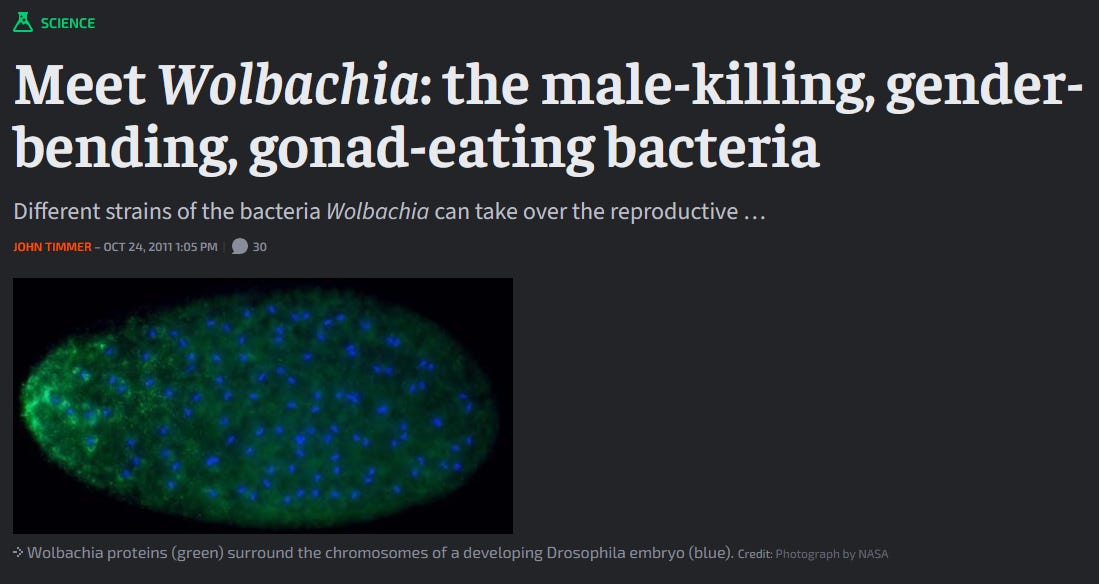
Wolbachia is a genus of bacteria numbering 8 different species. Some live in a symbiotic or mutualistic relationship with their hosts, but others are parasites with unique and bizarre abilities. Because it can only be transmitted through eggs, Wolbachia has evolved ways to manipulate sex ratios of its host’s offspring. Sometimes, it just gets rid of the males. Sometimes, it turns them into females. So far, research has identified some mechanisms behind its abilities. But we’re far from understanding the entire picture.
“Root Rot” by Saskia Nislow
A perplexing story with a pretty unique point-of-view structure, “Root Rot” will be more creepy than scary for most readers. The narrative revolves around a group of children, all members of a big extended family vacationing at an old countryside house. It belongs to one of my favourite subgenres - “sporror”, or fungal horror. And it continuously messes with your perception and perspective, obscuring the true threat at the core of the plot.
Fungi are the frequent subjects of horror for many reasons. One is aesthetic – many species of fungi are decomposers, which means they feed on dead organic matter. Because of that, we often associate mushrooms with death and decay, with abandoned places and dark corners of the woods.
Fungi are also a strange organism, more closely related to us than plants, yet living a drastically different survival strategy than animals. They are present everywhere, from the surface of our skin to the most remote corners of the Earth. They make our bread and our wine, they enrich the cuisine of many cultures, they infect our bodies and expand our minds. And there’s plenty fungal species that defy our understanding of biology, including radiation-feeding colonies and mind-controlling parasites.
However, perhaps the spookiest element of “Root Rot” for me was the “uncanny valley” effect that permeates its imagery. For some reason, I am very susceptible to the creepiness of “things that look just a little bit off”. I’ve played a lot of horror video games, and yet the only one so far that has given me nightmares has been “The Exit 8”, a game about navigating a (mostly) empty underground station. I guess my limbic system has very strong reactions to things it cannot comfortably categorize as either safe or unsafe.
https://scholarship.richmond.edu/osmosis/vol2025/iss1/6/
While we do not have much in the way of research on “uncanny valley”, there are some hypotheses that could explain it. For example, it is possible that early humans were vary of our close relatives, such as neanderthals or denisovans. However, we also know that humans have some genes from these extinct human species, so it seems like we were also forming communities and families with them. Alternatively, this response could be related to our aversion to signs of death and disease. After all, there are plenty of things in nature that can make a human look not quite like a human.
“Leech” by Hiron Ennes
It is not often that a debut novel will instantly convince me to add an author to my auto-read list, but “Leech” had done just that. Having read the second major title by Hiron Ennes, “The Works of Vermin”, it was an entirely justified decision.
This story is a sci-fi-ish horror-dystopia: darkly atmospheric, perplexing, and haunting. It follows a medical worker – a being part-human, part hivemind entity of unclear origin or intentions – tasked with attending to the frail patriarch of a remote mansion. (Yes, the remote mansion is a persistent trope in horror, and one I quite enjoy). What follows is a plot that I still cannot summarize in a concise manner. It is better to go into it knowing as little as possible.
Like “Root Rot”, this is a book with a unique POV. It is a little mind-bending, and a little existential. It challenges our ideas of self-determination, identity, and free will – all topics I spend a lot of time contemplating. And while there’s nothing remotely similar in the natural world I could link here, human brains are quite capable of splintering, fracturing, or being altered in all kinds of ways.
Mental illness can leave one without a stable identity, or personality, or a unified locus of control. Psychotic conditions can damage our perception of reality, and OCD can turn our thoughts against us. Strokes and brain injuries alter our brains and minds, too. They can make you functionality blind with perfectly healthy eyes, or only able to swear but not speak your native language. And in very, very rare cases, something going wrong in the brain can lead one to believe they are dead, despite continuing to breathe, move, and communicate.
Cotard’s syndrome is not considered a distinct diagnostic label – it is a kind of a delusion, a disorder of perception. It is unclear what causes it, and though it typically only lasts a few weeks or months, it can persist for much longer. We also don’t know exactly how it makes individuals believe they are dead. Possibly, it disrupts emotional responses, making one feel completely detached from life. Alternatively, it could impair whatever part of the brain that is responsible for making us feel alive. Either case, its existence serves as a reminder that brains are very complex and very delicate machines that can break in all sorts of ways.
“A Botanical Daughter” by Noah Medlock
This novel belongs to another niche category I adore: Frankenstein retellings. It is also a fungal/botanical horror, and it contains two separate queer romances (which are woven into the plot and the themes of the story).
One of the classic interpretations of the original work by Mary Shelley is a twisted metaphor of fatherhood and childrearing; a fantastical way of procreating that excludes women entirely. In “Botanical Daughter”, the desire to have children is one motivating factor to construct the creature, though it is also a story about the desire to be recognized and valued, as well as wonder and awe related to nature. It asks questions about identity and agency and love, and it leaves you thinking whether the conclusion of the plot is tragic outcome, a happy ending, or a bit of both.
The creature in this novel is born of human, fungal, and plant components – a symbiotic, compound being. In a manner of speaking, we are all compound beings. In our bodies, non-human cells outnumber human cells three-to-one or more, and we likely cannot function well without symbiotic bacteria inhabiting our digestive tracts and other organs. And symbiosis is plentiful in nature: coral, lichen, photosynthetic sea slugs, archea in the guts of termites, bacteria in the stomachs of herbivores... the list goes on.
We’ve known that plants and fungi work closely together for a long time. Mycorrhizal networks are essential for many trees (or even whole forests), and the decomposing abilities of fungi are essential to most ecosystems. However, increasingly, research is demonstrating that those ties are much tighter than previously believed.
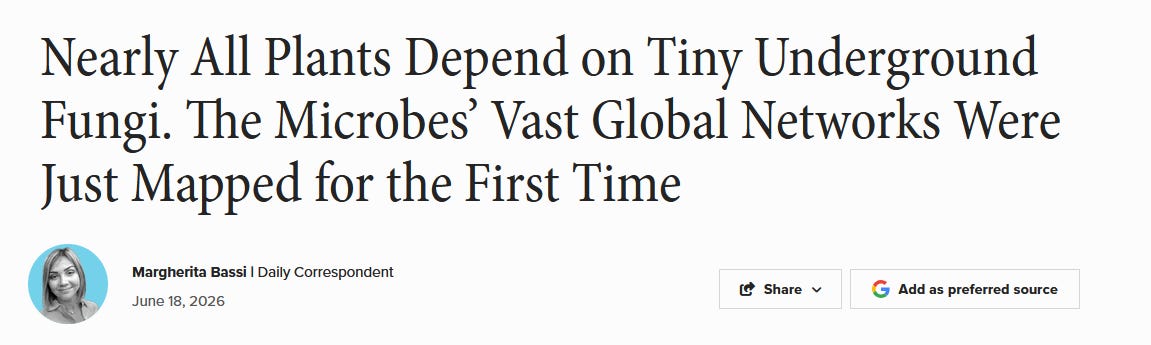
Just one type of fungus (arbuscular mycorrhizal fungi) appears to be so widespread on Earth, their sheer numbers boggle the mind. As the subtitle of the article states: “If lined up end to end, the thin, tubular threads that make up the arbuscular mycorrhizal fungal networks in Earth’s topsoil could stretch between our planet and the sun almost one billion times.” These fungi are essential for the plants and for the ecosystem as a whole. They serve a crucial role in nutrient transport and the carbon cycle, and facilitate communication between different organisms. And we still have plenty to learn about them.
*
Though horror remains a rather niche genre, I feel fairly optimistic about its future. Art and fiction are powerful tools for processing negative emotions, and horror is perfectly suited to tackle fear, disgust, and discomfort. In part thanks to the internet and indie publishing, it is also becoming much more diverse. Authors of all kinds of backgrounds are getting their voices heard; new, increasingly niche genres are sprouting and flourishing. And I’m very much hoping that biology will continue to feature in many horror stories to come.
Fear is not universally negative, especially when it comes to art. In some cases, fear is directly tied to awe. For example, I am terrified of the open ocean and deep-water environments – and I also love learning about them. A creeping dread can spark great curiosity and motivate you to find out more. So next time a living thing will creep the hell out of you, maybe look it up on Wikipedia. Knowing more can both relieve the fear and motivate you to pick up a horror title that ties into that moment of freight.